Moving to a new home is exciting. But packing your grandmother’s china? That’s terrifying.
One wrong turn, one overpacked box, one distracted moment and you’re sweeping up memories off the truck floor. The good news is protecting fragile items during a home move isn’t rocket science. It just takes the right materials, a little patience, and a game plan that actually works
This guide covers everything — from packing glassware and dishes to moving mirrors, artwork, and electronics safely. Let’s get into it.
Start Early: Don’t Leave Fragile Packing for Moving Day
One of the biggest mistakes people make is waiting too long. Fragile items need more time and attention than regular household stuff. Start packing delicate items at least two weeks before your move date — ideally three to four weeks for large collections like china, antiques, or a full bar cabinet.
Rushing through fragile packing is how things break. Give yourself time to do it right, one category at a time.
If you’re working through your full moving timeline, our Moving Day Checklist is a great place to start — it helps you plan tasks week by week so nothing sneaks up on you.
Best Packing Materials for Fragile Items
Before you pack a single thing, gather your supplies. Using the wrong materials is one of the fastest ways to end up with broken items.
Here’s what professional movers use and recommend:
Bubble wrap — The gold standard for wrapping individual fragile items. Use large-bubble wrap for heavier items like vases and figurines, and small-bubble wrap for thinner glass and dishware.
Packing paper (newsprint) — Ideal for wrapping dishes, cups, and bowls. It’s softer than newspaper and won’t leave ink on your items. Use multiple layers.
Foam pouches — Pre-made foam sleeves work great for wine glasses and stemware. They’re reusable and save time.
Packing peanuts or crumpled paper — Use these as filler inside boxes to prevent items from shifting during transit.
Sturdy double-walled boxes — Regular moving boxes aren’t always enough. For heavy or very fragile items, double-walled boxes add an extra layer of protection.
Dish packs (cell boxes) — These are specialty boxes divided into individual cells, perfect for glasses and stemware.
Soft household items — Towels, blankets, clothing, and linens make surprisingly effective padding. They’re free, they travel anyway, and they cushion well.
Pro tip: Never use trash bags for fragile items. They offer zero protection and shift constantly.
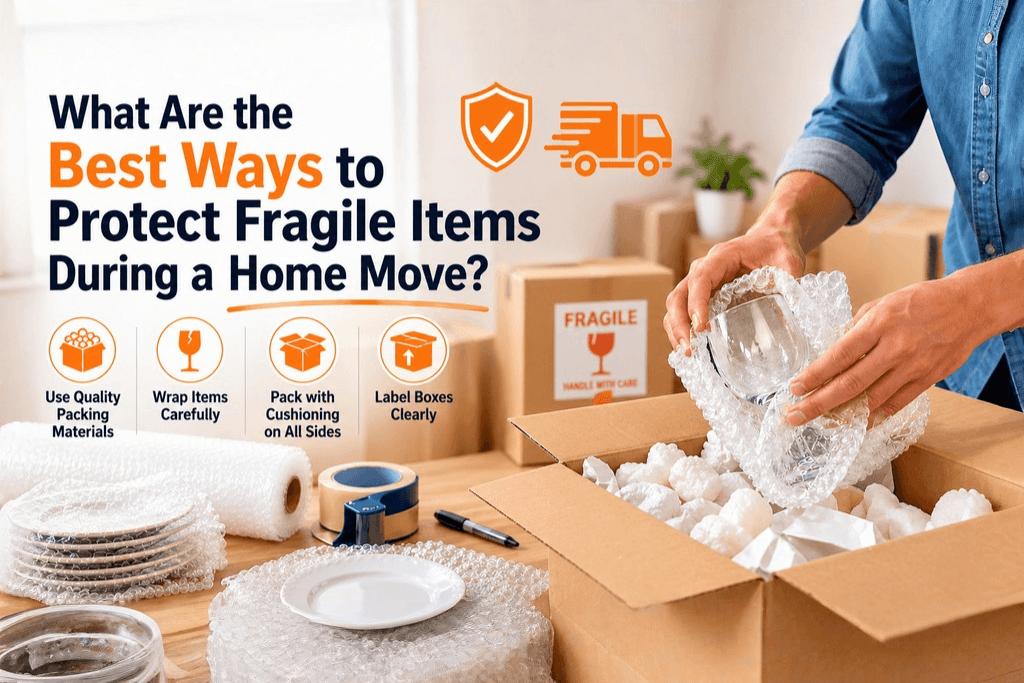
How to Pack Dishes for Moving Safely
Dishes are one of the most common casualties during a move. Here’s how to pack them so they actually survive
Wrap each dish individually. Lay a sheet of packing paper flat, place the dish in the center at an angle, and fold the corners over. Wrap a second sheet around the whole thing.
Pack plates vertically, not flat. This surprises a lot of people, but plates are much stronger on their edges. Stacking them flat puts pressure directly on the surface, not ideal. Think of it like vinyl records in a crate.
Add a cushion layer. Line the bottom of your dish box with two to three inches of crumpled packing paper or a folded towel before placing any dishes.
Don’t overfill the box. When you close the lid, there should be no bulging and no rattling. If items shift when you shake the box, add more paper.
Label it correctly. Write “FRAGILE – DISHES – THIS SIDE UP” on at least two sides of the box. More on labeling shortly.
How to Pack Wine Glasses and Stemware
Wine glasses are notorious for breaking during moves, those long stems snap easily. Here’s how to protect them.
Use foam pouches or wrap each glass in two to three sheets of packing paper. Always wrap from the stem first, then spiral up toward the bowl.
Pack glasses upside down in a dish pack or cell box so the rim (the most fragile part) isn’t taking direct weight.
Fill any hollow space inside the glass bowl with crumpled paper before wrapping, this keeps the glass from collapsing inward if pressure is applied.
Place heavier glasses on the bottom of the box and lighter ones on top. Never stack glasses directly on each other.
How to Pack and Protect Mirrors During a Move
Mirrors are awkward, heavy, and one of the most anxiety-inducing things to move. Here’s the right approach.
Use mirror boxes. These are adjustable flat boxes made specifically for mirrors and framed artwork. They telescope to fit different sizes, worth every dollar.
Apply painter’s tape in an X across the glass. This won’t prevent cracks if it takes a hard hit, but if the mirror does break, it holds the shards together and makes cleanup safer.
Wrap the entire mirror in bubble wrap or moving blankets before sliding it into the box.
Move mirrors vertically — never lay them flat in a truck. Store them against a wall, padded on both sides.
For large wall mirrors or full-length mirrors, consider asking your residential moving team to handle them. One wrong grip and a large mirror can crack under its own weight.
How to Pack Artwork for Moving
Artwork, especially framed pieces, needs a similar approach to mirrors but with a bit more finesse.
For framed art with glass fronts, tape an X across the glass with painter’s tape. Wrap the frame in several layers of bubble wrap, securing it with packing tape (not touching the frame itself).
For canvas art without glass, wrap loosely in acid-free paper or glassine paper first to protect the surface, then bubble wrap on top.
Pack each piece in its own mirror/picture box. If you’re stacking multiple pieces, place a layer of cardboard or foam board between them.
Never pack artwork in standard boxes with other items. One shifting vase is all it takes.
How to Protect Antiques During a Move
Antiques deserve special treatment. They’re often irreplaceable, and standard packing sometimes just isn’t enough.
For antique furniture, use moving blankets or furniture pads to wrap legs, arms, and any ornate details. Secure the padding with stretch wrap, but never apply stretch wrap directly to wood or fabric surfaces, as it can damage finishes.
For smaller antiques, figurines, pottery, decorative pieces, wrap each one individually in acid-free tissue paper first, then bubble wrap. Double-box high-value pieces (place the wrapped item in a smaller box, then pack that box inside a larger one with padding all around).
If you have antiques of significant value, photograph each piece before packing. This documentation matters if you ever need to file a claim.
For truly irreplaceable or high-value antiques, consult a professional moving company experienced in specialty moves. The peace of mind is worth it.
How to Pack Electronics for Moving
Electronics are fragile in a different way, they’re sensitive to shock, static, and temperature. Here’s how to pack them safely.
Best option: original boxes. If you kept them, use them. Manufacturer packaging is engineered specifically for those devices.
If you don’t have original boxes, here’s what to do:
- Wrap the device in anti-static bubble wrap (not regular bubble wrap, which can build up static electricity near sensitive components).
- Place it in a sturdy box with at least two inches of padding on all sides.
- Remove all cables, batteries, and accessories and pack them separately.
- For TVs, use a TV moving box, these are available at moving supply stores and often at big-box retailers.
Back up your data before the move. Drives can fail from vibration alone.
Label every electronics box clearly. Also note which cables belong to which device future you will be grateful.
How to Secure Fragile Items Inside the Moving Truck
You did everything right with the packing. Now don’t blow it by loading the truck carelessly.
Load heavy boxes first. They go on the floor, against the truck walls. Fragile boxes go on top, never beneath heavier items.
Fill gaps between boxes. Use moving blankets, pillows, or soft bags to prevent boxes from shifting during transit. A box that slides around is a box that breaks.
Use tie-down straps. Most moving trucks have anchor points along the walls. Use straps to create zones that keep items from rolling or tipping.
Keep fragile items away from the truck ramp area. That’s where the most jolting and vibration happens during loading and unloading.
Don’t stack fragile boxes too high. Even if they’re labeled, taller stacks are unstable on a moving truck.
Our residential moving services include careful loading and securing of all your belongings — including the delicate stuff — so you’re not playing Jenga with your dishes in the back of a truck.
How to Label Fragile Moving Boxes the Right Way
Labeling matters more than people realize. A box marked correctly gets handled differently by everyone who touches it.
Write “FRAGILE” in large, bold letters on every side of the box — not just the top. People pick up boxes from the side, and if the label is only on top, they might not see it.
Add “THIS SIDE UP” with an arrow on any box where orientation matters (dishes, stemware, lamps).
Include a brief content description — “wine glasses,” “ceramic bowls,” “picture frames.” This helps you and your movers prioritize which boxes need extra care and in what order to unload.
Use a bright-colored label or marker for fragile boxes so they visually stand out in a sea of brown cardboard.
Cheap Alternatives to Bubble Wrap
Running low on supplies or trying to move on a budget? You’ve got options.
Clothing and soft linens are one of the best free alternatives to bubble wrap. T-shirts, socks, dish towels, wrap your items in these. They travel anyway, so you’re doubling up.
Newspaper works in a pinch, though it can leave ink marks. Wrap items in a layer of clean paper first if you go this route.
Egg cartons work surprisingly well for small figurines and ornaments.
Foam mattress toppers can be cut into custom-sized pieces for oddly shaped items.
Suitcases are excellent for transporting fragile items, they’re padded, they close securely, and they have handles. Pack your most delicate items in suitcases surrounded by soft clothing.
Special Consideration: Moving Sentimental Items
Some things can’t be replaced, not with money, not with anything. Wedding gifts. Inherited pieces. Items tied to people you’ve lost.
For these, consider carrying them yourself in your personal vehicle rather than loading them in the truck. A small box in your back seat is safer than any amount of bubble wrap in a moving van.
If you must pack them, double-box them, label them clearly, and tell your movers specifically which boxes to treat with extra care.
And take photos of everything before packing. You’ll be glad you did.
Fragile Item Packing Checklist for Moving Day
Here’s a quick checklist to run through before sealing any fragile box:
- Each item wrapped individually
- Cushion layer on bottom of box (2–3 inches)
- No empty space or rattling inside
- Heavier items on bottom, lighter on top
- Box is not overpacked or bulging
- Lid closes flat without forcing
- “FRAGILE” labeled on all four sides
- “THIS SIDE UP” marked where applicable
- Contents written on the outside
Use this alongside our complete Moving Day Checklist to make sure nothing slips through the cracks on your move day
When to Call Professional Movers for Fragile Items
Some moves, and some items, genuinely need a professional touch.
If you’re moving a large collection of antiques, high-value art, a piano, a grandfather clock, or irreplaceable heirlooms, hiring experienced movers isn’t an extravagance. It’s just smart risk management.
At McMinn Moving N More, we handle your belongings with the same care we’d give our own. Our team is experienced in residential moves across Athens, Sweetwater, Loudon, Lenoir City, Cleveland, and surrounding areas in East Tennessee. We treat every box fragile or not like it matters. Because it does.
Request a free quote today and get 10% off your move when you book online.
FAQs:
1. How do I protect fragile items during a home move?
The key is layering protection: wrap each item individually in packing paper or bubble wrap, use sturdy boxes with cushioning on the bottom and sides, pack items snugly so nothing shifts, and label every box as fragile on all sides. Don’t rush fragile packing takes time. Load fragile boxes on top of heavy items in the truck, and secure everything with blankets and tie-down straps to prevent movement during transit.
2.What is the safest way to pack fragile items for moving?
The safest approach is to use purpose-built supplies: double-walled boxes, cell dividers for glasses, foam pouches for stemware, and bubble wrap for individual items. Pack plates vertically, not flat. Fill empty space with crumpled paper so nothing can shift. For extremely valuable or irreplaceable pieces, double-boxing (a wrapped item inside a smaller box, inside a larger padded box) provides the best protection available without custom crating.
3. Should I use bubble wrap or packing paper for fragile items?
Both they serve different purposes. Packing paper is great as the first layer directly against the item, especially for dishes and bowls. Bubble wrap adds the impact-absorbing cushion layer on top. Using packing paper first prevents scratches, while bubble wrap handles the bumps. For wine glasses, foam pouches work better than either because they’re shaped for stemware and quicker to use.
4. How do I pack wine glasses and dishes for moving?
Wrap each dish individually in packing paper and pack plates standing on their edges not flat in dish boxes lined with two to three inches of padding. For wine glasses, use foam pouches or wrap from the stem upward and pack them upside down in cell dividers. Never stack glasses directly on each other. Fill any hollow space inside glass bowls with crumpled paper to prevent collapse under pressure.
5. How do movers protect antiques during a move?
Professional movers use moving blankets and furniture pads on antique furniture, carefully wrapping legs, corners, and ornate features. Smaller antique pieces get wrapped in acid-free tissue paper first, then bubble wrap, then packed in double-walled boxes. High-value antiques are sometimes double-boxed for extra protection. Movers also document condition with photos before packing and keep antique boxes separated from heavier household items during loading.
6. How do I move mirrors and artwork safely?
Use adjustable mirror boxes for framed mirrors and artwork. Apply painter’s tape in an X across any glass surfaces — this won’t prevent cracking but keeps shards contained if a break occurs. Wrap the entire piece in bubble wrap before boxing. Always move mirrors and framed art vertically, never flat. In the truck, lean them padded against walls and secure them so they can’t fall or slide during transit.
7. What is the best way to pack electronics for moving?
Use original manufacturer packaging whenever possible — it’s engineered for that specific device. If you don’t have it, wrap electronics in anti-static bubble wrap and pack them in sturdy boxes with at least two inches of padding on all sides. Remove batteries, cables, and accessories and pack them separately. Back up all important data before moving day. Label boxes clearly and note which cables belong to which device to save yourself headaches at the new place.
8. How do I secure fragile items inside a moving truck?
Load fragile boxes last (or near last) so they ride on top of heavier items. Place them against stable surfaces and fill gaps between boxes using moving blankets or soft bags. Use anchor straps at the truck walls to create stable sections. Keep fragile items away from the ramp area where the most vibration occurs. The goal is zero shifting — if a box can move, it will move, and moving means breaking.
9. Can towels and clothes protect fragile items while moving?
Absolutely household soft items are one of the most underused packing tools. T-shirts, dish towels, socks, and linens work well as wrapping material and box filler. They provide decent cushioning, cost nothing extra, and travel with you anyway. That said, for very delicate items like fine china, crystal, or antiques, supplement soft items with bubble wrap. Don’t rely on clothing alone for anything with extreme fragility or sentimental value.
10. What mistakes should I avoid when packing fragile items?
The biggest ones: packing too fast, using flimsy single-wall boxes, laying plates flat, overpacking boxes until they bulge, leaving empty space that allows movement, and skipping labels. Another common mistake is placing fragile boxes on the bottom of a stack in the truck. Also avoid wrapping directly with newspaper — the ink transfers and can stain items. And never assume someone else knows which boxes are fragile; label every single one yourself.
McMinn Moving N More is a locally owned moving company serving Athens, TN and surrounding areas. We offer residential moving, commercial moving, and junk removal services with honest pricing and no hidden fees. Get a free quote today.